
Knowing how to motivate your team is the difference between a group of people showing up and a group of people moving forward together.
The quotes are easy to find.
The conviction behind them is what most leaders are missing.
Picture yourself in a narrow cell, the air thick with regret and fluorescent hum, where Tony stared at a chipped ceiling and wondered if he’d ever get a second chance.
It’s an extreme place to find hope, yet the very lessons that helped him claw his way back from rock bottom hold a hidden power for anyone leading a team.
What if the spark your team needs doesn’t come from another motivational seminar, but from the raw honesty and resilience that’s born out of struggle?
Leadership: How to Motivate Your Team
Great teamwork does not happen because everyone is talented.
It happens because someone decided to create a common vision and make every individual member feel like they are a crucial ingredient in something bigger than themselves.
As American basketball player Michael Jordan put it, talent wins games, but it takes a group effort to win championships. That idea cuts to the core of what separates an enthusiastic team from one that just clocks in and clocks out.
If you want to bring a message about team motivation, individual commitment, and what it actually takes to attain uncommon results, motivational speaking is where that shift begins.
Beyond Carrots and Sticks: What Really Motivates a Team
Right now, traditional “carrot and stick” motivation is failing across the board. You cannot just dangle a bonus or threaten a write-up to inspire team work and expect lasting dedication. In fact, recent data shows that global employee engagement has hit a decade low, with a staggering 31 percent of workers feeling actively engaged.
The old methods of using simple rewards and punishments actually extinguish intrinsic motivation and stifle the higher-order creativity needed in today’s company work.
Surface-level perks like free coffee in the breakroom or a generic annual bonus simply do not build the deep, emotional resilience required to navigate real challenges.
When Tony Hoffman was sitting in a prison cell, his ultimate transformation did not start because someone offered him a prize for good behavior.
It started with a fundamental shift in perspective and a deep, authentic connection to a completely new purpose. You can do the same with society work and team work.
Authentic storytelling and emotional vulnerability motivate people far more effectively than any rigid reward system because they fulfill our innate psychological needs for autonomy, competence, and meaningful connection.
Think of Abraham Lincoln, Steve Jobs, Virginia Burden, Andrew Carnegie, an American actress, an American businessman, an American novelist, and Mother Teresa. People are inspired by other people who lived well and showed how it’s done.
When you ditch the carrots and sticks, you open the door to real leadership.
You start engaging people as complex human beings, not just cogs in a machine. This shift builds an environment where people want to work hard because they feel valued, understood, and actively part of a shared mission.
Strategy 1: Build Psychological Safety Through Authentic Leadership
What does psychological safety actually look like in practice?
In the corporate world, it means your team feels safe to take interpersonal risks and admit mistakes without fear of humiliation or punishment. But if you look at it through the lens of addiction recovery, it is about radical honesty.
In a recovery group, healing only begins when someone has the courage to stand up, strip away their ego, and say, “I am struggling, and I need help.”
For example, clinical research on Psychological Safety and Learning Behavior in Work Teams shows that safety drives performance.
To foster this, you need to step back and listen.
Effective leaders listen 80 percent of the time. When you ask your team what you are missing and truly hear them, you replace fear with unshakeable empowerment.
Strategy 2: Set Clear Goals That Fuel a Shared Vision
Setting goals isn’t just about hitting quarterly targets; it is about instilling a profound sense of purpose. In addiction recovery, a clear vision is quite literally a matter of life and death.
When Tony was in prison, his initial vision was singular and raw: get out and stay sober.
But that massive, intimidating vision had to be broken down into daily, manageable objectives to prevent total overwhelm. The exact same principle applies to how you drive your team forward.
How do you motivate your team when everyone is driven by different goals? You unite them under a shared vision, while giving them the autonomy to determine how they get there.
Here is how you can use goal-setting to build unstoppable momentum:
- Break down the big picture: Translate massive company goals into small, achievable milestones. This builds hope and proves that progress is possible, much like taking recovery one single day at a time.
- Involve your team in the process: When people have a say in setting their own objectives, they feel a deep sense of ownership. Autonomy fuels intrinsic motivation far better than rigid micromanagement.
- Ensure goals are SMART: Use specific, measurable, achievable, relevant, and time-bound goals. As seen in clinical research on Using SMART Goals to Make Scientific Progress, this clarity eliminates confusion and gives everyone a concrete roadmap.
- Connect daily tasks to the deeper vision: Regularly remind your team how their specific roles contribute to the larger mission. When individual efforts align with a shared purpose, differing personal motivations naturally weave together to support the team’s ultimate success.
Strategy 3: Recognize the Journey, Not Just the Summit
It is time to completely reframe how we view rewards and recognition in the workplace.
Too often, leaders only celebrate the massive victories, such as the closed deal, the finished project, or the record-breaking quarter. But if you only recognize the summit, you ignore the grueling climb it took to get there.
In the recovery community, people do not wait for a final cure to celebrate.
They honor the journey by celebrating 30 days sober, 60 days, and one year.
They acknowledge the daily grind, the inevitable setbacks, and the sheer resilience required to keep moving forward. You must apply this exact same mindset to your team.
Providing consistent, positive feedback for the effort, not just the outcome, makes people feel truly seen.
Strategy 4: Inspire Resilience with Motivational Stories and Quotes
Never underestimate the power of a well-timed story to spark genuine inspiration. When you are figuring out how to lift your people up, authentic stories and team motivational quotes serve as incredibly potent anchors. This creates a deep sense of empathy, connection, and narrative transportation.
| Situation | Authentic Quote (Grounded in Hope) | Common Pitfall (Empty Jargon) |
|---|---|---|
| Facing a Setback | “This is tough, but our greatest growth comes from challenges like this. What did we learn?” | “Let’s pivot and leverage our learnings moving forward.” |
| Dealing with Burnout | “Your well-being matters more than this deadline. Let’s recalibrate and take care of ourselves.” | “We just need to give 110% and push through the pain points.” |
| Navigating Uncertainty | “I don’t have all the answers right now, but I trust this team to figure it out together.” | “Let’s synergize our core competencies to optimize the unknown.” |
We literally feel the hope and perseverance of the storyteller.
This is exactly why famous leaders throughout history have used storytelling to guide their teams through massive crises.
Team motivation is not one-size-fits-all, and a great motivational speaker knows how to read the room whether the audience is students learning how to carry individual commitment without losing the group effort, college students hitting their first real test of teamwork through challenging times, employees in healthcare fighting burnout while trying to find purpose in the work, or communities dealing with addiction and rebuilding trust one small win at a time.
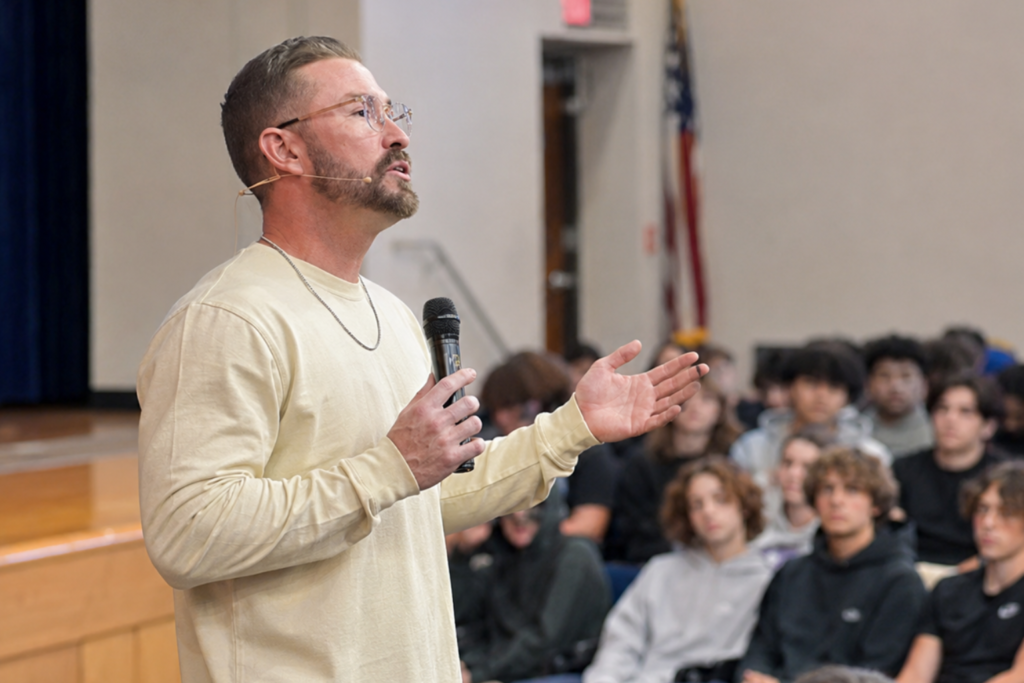
As a motivational speaker for schools, a leading voice among motivational speakers for college students, a trusted mental health speaker, one of the most impactful substance abuse speakers working today, an in-demand healthcare motivational speaker, and one of the most sought-after Christian speakers for churches and faith-based organizations, Tony brings the kind of thorough conviction and focus that inspirational quotes alone never deliver, connecting real stories to the crucial ingredient every enthusiastic team needs to attain uncommon results and keep moving forward.

Leading Your Team with Authenticity
Figuring out how do you motivate your team isn’t about memorizing a checklist of management tactics.
It is about a fundamental shift in your mindset toward authenticity, empathy, and vulnerability.
True leadership requires you to build unshakeable trust, set a clear and shared vision, recognize the grueling journey instead of just the summit, and use the power of storytelling to inspire real resilience.
Tony Hoffman’s journey from a prison cell to international stages proves that no situation is beyond redemption.
No challenge is too great when you have hope and resilience on your side.
You have the power to bring that same transformative energy to your own organization.
The Right Message Changes Everything
How to motivate your team as a leader comes down to one thing: making people feel like what they do matters.
Not through inspirational quotes pinned to a break room wall, but through a message with thorough conviction delivered by someone who has lived it.
Tony Hoffman brings that blueprint to life for teams across industries, from schools and college campuses to healthcare systems and recovery organizations.
If you are ready to build a team that moves forward with focus and purpose, contact us or call (888) 707-3880 and let’s make it happen.
Sources
Edmondson, A. C. (1999). Psychological Safety and Learning Behavior in Work Teams. Administrative Science Quarterly, 44(2), 350–383.
Zak, P. J. (2015). Why Inspiring Stories Make Us React: The Neuroscience of Narrative. Cerebrum, 2.
Hassmén, P., Koivula, N., & Udevitz, B. (2018). Goal Setting in Teams: Goal Clarity and Team Performance in Online Teamwork. Frontiers in Psychology, 9, 2505.
Wang, Y., & Zhang, J. (2021). The mechanism of goal-setting participation’s impact on employees’ proactive behavior: a moderated mediation model. Frontiers in Psychology, 12, 788124.
National Institute of Health. (2016). Using SMART Goals to Make Scientific Progress. Intramural Research Program.
Substance Abuse and Mental Health Services Administration. (n.d.). Setting Goals and Developing Specific, Measurable, Achievable, Relevant, and Time-Bound (SMART) Objectives. SAMHSA.
Substance Abuse and Mental Health Services Administration. (2024). Developing Goals and Measurable Objectives. SAMHSA.
Doran, G. T. (1981). SMART Goals: A How to Guide. Management Review.
University of Wisconsin School of Medicine and Public Health. (n.d.). How to Set a SMART Goal. University of Wisconsin.
Kleingeld, A., van Mierlo, H., & Arends, L. (2011). The Effect of Goal Setting on Group Performance: A Meta-Analysis. Journal of Applied Psychology, 96(6), 1289–1304.
Tsai, F. M., & Cheng, J. H. (2011). Relationship between Organizational Culture, Leadership Behavior and Job Satisfaction. BMC Health Services Research, 11, 98.
University of Illinois at Urbana-Champaign. (2022). A field study of turnaround attempts from firm-based decline. University of Illinois.
Aston University. (2023). NAVIGATING THE TURNAROUND PROCESS. Aston University.
Kenya University. (2020). Theoretical Review of Turnaround Strategy and Its Implementation. Kenya University.
Brüning, J., et al. (2023). Definitions of resilience and resilience resource use as described by adults with congenital heart disease. International Journal of Cardiology. Heart & Vasculature, 45, 101175.
Dyrbye, L. N., et al. (2016). Medical student resilience strategies: A content analysis of medical student portfolios. Academic Medicine, 91(12), 1684–1691.
Fasser, B. A., et al. (2020). Promoting Resilience in Medicine: The Effects of a Mind–Body Intervention. Global Advances in Health and Medicine, 9.
Epstein, R. M., & Krasner, M. S. (2013). Physician resilience: what it means, why it matters, and how to promote it. Academic Medicine, 88(3), 301–303.
Thompson, G., et al. (2018). Strategies for enhancing medical student resilience. Medical Education, 52(5), 508–518.
Alam, F., et al. (2025). Unfolding insights about resilience and its coping strategies by medical students: a qualitative study. BMC Medical Education, 25(1), 45.
Yotsidi, V., et al. (2024). Interventions to promote resilience and passion for work in health professionals: a scoping review. BMC Health Services Research, 24(1), 1123.
Guerra-Martín, M. D., et al. (2023). Resilience, Positivity and Social Support as Perceived Stress Buffers of University Students during the COVID-19 Pandemic Lockdown. International Journal of Environmental Research and Public Health, 20(19), 6861.
Houghton, C., et al. (2019). Resilience: a nationwide study of medical educators. Irish Journal of Medical Science, 188(2), 375–382.
FAQ
How do you motivate your team as a leader?
Motivating a team starts with individual connection before collective inspiration. Leaders who know their team members, recognize small wins, and communicate a common vision consistently create the kind of environment where people want to show up. No teamwork quote replaces genuine investment in the people doing the work.
What are some powerful motivational quotes for a work team?
A few that cut to the point: Michael Jordan on talent winning games but teamwork winning championships. Henry Ford on coming together as a beginning and working together as success. Helen Keller on alone going fast but together going far. The best team motivational quotes are the ones leaders can back up with their own actions.
How do you inspire teamwork in challenging times?
In challenging times, inspiration comes from honesty, not performance. Acknowledge what is hard. Celebrate small wins. Keep individual members connected to the larger purpose. An inspirational speaker can reset the energy in a room, but the leader has to carry that message forward every single day through consistency and individual commitment.
What makes a team highly motivated?
A highly motivated team has three things: a clear common vision, individual members who feel valued, and a culture where people are not afraid to fail forward. Motivation is not a feeling you manufacture with inspirational quotes. It is a byproduct of a team that trusts its leadership and believes the work they are doing actually matters.
Why is individual commitment important for team success?
Individual commitment is the crucial ingredient that separates a group effort from real teamwork. Phil Jackson, Stephen Covey, and virtually every great team builder in history said the same thing in different ways: the team is only as strong as each person’s decision to show up fully. One person going through the motions can pull down an entire team. One person going all in can bring the whole thing to life.
Author

Pro BMX athlete. Recovering addict. Motivational speaker. Tony Hoffman has lived several lives, and now he shares all of them. Since his release from prison in 2008, Tony has become one of the most powerful voices in mental health and substance abuse awareness.