
Great leaders do not happen by accident.
They are built through real experience, hard choices, and the commitment to develop others.
Tony Hoffman brings positive leadership to life through raw, honest storytelling. He has lived the consequences of bad choices and fought his way back to build something real.
Picture yourself in a stark prison cell, fluorescent lights buzzing overhead and the weight of addiction pressing heavy on your chest this was Tony Hoffman’s reality at his lowest point, trapped by meth and despair.
Yet, even in that bleakness, something changed: a spark of genuine hope pushed him to lead himself out, step by step, toward becoming a pro BMX rider and advocate.
If you or someone you love is searching for a way forward, understanding this kind of leadership can make all the difference.
Positive Leadership Quotes
The very essence of leadership is not about holding a title. It is about what you do with your influence. Peter Drucker said, “The most important thing in communication is to hear what isn’t being said.”
Warren Bennis believed a great leader takes people where they want to go, but a great leader also takes people where they need to go.
Jon Gordon put it plainly: an optimist expects it to change, a pessimist complains about the wind, and a leader adjusts the sails.
Ralph Nader said, “The function of leadership is to produce more leaders, not more followers.”
For a deeper look at how Tony brings these ideas to life, visit his motivational speaking page.
What Is Positive Leadership?
True positive leadership has nothing to do with toxic positivity.
It is not about painting a smile over a broken system or ignoring the deep pain people carry.
Instead, positive leadership involves acknowledging immense struggle while actively choosing optimism, resilience, and compassion. It requires a leader to look at a devastating situation, see the brutal reality, and still chart a course toward hope.
Tony’s Story
For Tony Hoffman, this concept is not just a corporate buzzword.
It is a literal lifeline.
Going from a prison inmate battling severe methamphetamine use to a professional BMX rider required a radical shift in mindset. He had to lead himself first.
By refusing to let his past define his future, he discovered the core of authentic leadership. This type of leadership demands that you face your darkest moments head-on. Only then can you guide others toward the light.
In professional settings, researchers call this concept organizational virtuousness. This means an organization commits to ethical behavior, deep trust, and genuine human connection.
However, organizational virtuousness does not just belong in corporate boardrooms. It is vital for treatment centers, schools, and faith-based communities.
When you cultivate these virtues, you create an environment where people feel safe enough to change. You can see this clearly in the virtues of effective crisis leadership, which show that empathy and courage directly build collective resilience.
Positive Leadership Techniques
Traditional, punitive leadership models fail spectacularly in high-stress or trauma-heavy situations. You cannot punish someone into lasting recovery.
When leaders rely on fear or rigid compliance, they strip away a person’s remaining dignity. This breaks trust and destroys any chance of meaningful connection.
If you want to transform lives, you must embrace a leadership style built on grace and unwavering support.
A skilled mental health speaker understands that real virtue is forged in the fire of adversity. People need leaders who understand their pain without judging their past.
Positive leadership means extending a hand into the dark, offering real tools for change, and holding the belief that every single person is capable of redemption. It is a daily choice to build culture around human potential rather than human failure.
Traits of a Positive Leader
When you look closely at organizations that thrive, you will find leaders who actively model resilience and growth.
These traits are not innate gifts given at birth.
They are forged in the fire of real-world experience, failure, and recovery.
Good leaders are truly made, not born.
Care and Support
Genuine care is the only tool strong enough to break down the heavy walls of defensiveness.
In both business and recovery, people simply do not care how much you know until they know how much you care.
A leader who models emotional vulnerability gives others the permission to be honest about their own struggles. When you support someone through their darkest days, you build a foundation of absolute loyalty and trust.
Empowerment
A cornerstone of positive leadership is the strength-based approach. Instead of highlighting an individual’s past failures, positive leaders focus entirely on building inherent strengths.
It is incredibly common for people in recovery to feel defined by their worst mistakes. Empowering them means shifting that narrative completely. You must help them see what they are capable of achieving today.
Authenticity
Authenticity is absolutely non-negotiable if you want to impact lives.
Audiences, especially youth and those navigating the recovery process, can spot fake positivity in an instant.
When a leader stands on a stage or sits in a circle and tells the raw truth, it shatters shame in the room.
The Strategic Advantages of Positive Leadership
Positive leadership provides a massive strategic advantage for organizations, schools, and faith-based communities alike. When you shift away from control and move toward connection, everything changes. People begin to work harder, heal faster, and collaborate more deeply.
This is not just a nice idea.
It is a proven driver of better outcomes.
| Focus Area | Traditional Leadership | Positive Leadership |
|---|---|---|
| Handling Failure | Punishes mistakes and assigns harsh blame. | Views failure as a vital learning opportunity. |
| Communication | Relies on one-way directives and closed doors. | Fosters open dialogue and active listening. |
| Motivation | Uses fear, threats, and strict compliance. | Builds intrinsic drive through purpose and vision. |
| Human Connection | Maintains cold, professional distance at all times. | Prioritizes deep empathy and relational trust. |
As you can see in the comparison above, traditional leadership often relies on fear to maintain order.
Positive leadership, however, relies on empowerment.
This is incredibly important in high-stress environments.
Whether you are leading a corporate sales team or working as a healthcare motivational speaker, people need to feel valued to perform their best.
One of the greatest benefits of this approach is psychological safety. When team members feel safe, they are far more likely to share innovative ideas and admit when they need help.
In fact, research shows a direct impact on employee engagement when leaders practice positive reinforcement. People simply do not want to leave organizations that treat them with profound dignity.

Positive Leadership Quotes from Tony Hoffman
Words carry incredible power when you are fighting through the trenches of life. Having the right positive leadership quotes front-of-mind can serve as a mental anchor during chaos.
Tony Hoffman often says, “The darkest moments of our lives are often the setup for our greatest impact.” This philosophy of redemption and grit is exactly what leaders need to embrace.
When you face heavy resistance, turning to positive communication helps reframe the narrative.
You have to remind yourself and your team that pain is rarely permanent.
Your words can either tear down an organization or build a sanctuary of hope.
Choose to use them to empower, uplift, and transform every single person you lead.
How to Get Started with Positive Leadership
Cultivating a positive climate does not happen by accident. It requires intentional, daily habits that completely transform how you interact with others. If you want to build a culture of true professional growth and deep collaboration, you have to start with your own actions. Here is an actionable guide to help you begin this journey today.
- Change your language: You must speak life, not condemnation. Replace judgmental phrasing with words that affirm a person’s worth and potential.
- Empower your team: Give people genuine ownership over their tasks and their recovery. Trusting them builds confidence and drastically improves daily performance.
- Lead by example: You have to model the hard work of resilience. Show your team how to handle failure with grace and how to bounce back stronger.
- Practice daily reflection: Take time to ground yourself mentally. Incorporating the positive leadership action framework helps align your values with your daily decisions.
- Anchor in spiritual grounding: Recognize that lasting transformation often requires faith. Connecting to a higher purpose keeps you steady when the work gets exhausting.
Positive leadership is not just an academic theory.
For people fighting for their lives, it is a literal lifeline.
Addiction Speaker for Schools and Rehab Programs
Tony lost years of his life to addiction. He knows exactly what denial feels like. He knows the shame, the doubt, the moment a person thinks there is no way out.
His message as a substance abuse speaker cuts through the noise. He does not lecture. He tells the truth.
Mental Health Speaker
Negativity and adversity are real. So is the ability to push through them. Tony connects mental health challenges to leadership principles in a way people barely expect.
As a mental health speaker, Tony addresses anxiety, identity, and the inner battles that keep people from reaching new heights. He teaches that mental strength is built, not inherited.
He focuses on practical habits.
He talks about the power of relationships, commitment, and the energy it takes to lead yourself before you lead anyone else.
Motivation Speaker for Schools and Youth
Motivation is not a feeling. It is a practice. Tony teaches young people that the difference between those who thrive and those who quit comes down to daily decisions.
As a motivational speaker for schools, Tony connects with students on their level. No corporate buzzwords. No empty hype.
He talks about what it means to aim fulfilled, to focus on the bigger picture, and to create a life worth living on purpose.
Leadership and Empowerment
Tony’s leadership talks cover shared vision, teamwork, and what it really means to develop leaders inside an organization. He draws on real principles, from former CEO examples to street-level reality.
He challenges managers to become true leaders. He talks about how a leader adjusts under pressure, how a leader takes responsibility, and why the main thing must stay the main thing.
Student Athlete Speaker
Champions are not made in the spotlight. They are made in the practices no one watches.
Tony speaks directly to student athletes about adversity, commitment, and the responsibility that comes with influence.
He connects athletic principles to real life. Teamwork, confidence, and the focus to achieve go far beyond any scoreboard.
Christian and Faith-Based Speaker
Faith is not weakness. It is the foundation that gives a person the hope to keep going when reality says stop. T
Tony speaks openly about how faith shaped his comeback.
As one of the most in-demand Christian speakers for youth and churches, Tony connects belief to action.
He talks about what it means to live out your principles every single day.
Bring Positive Leadership to Your Event
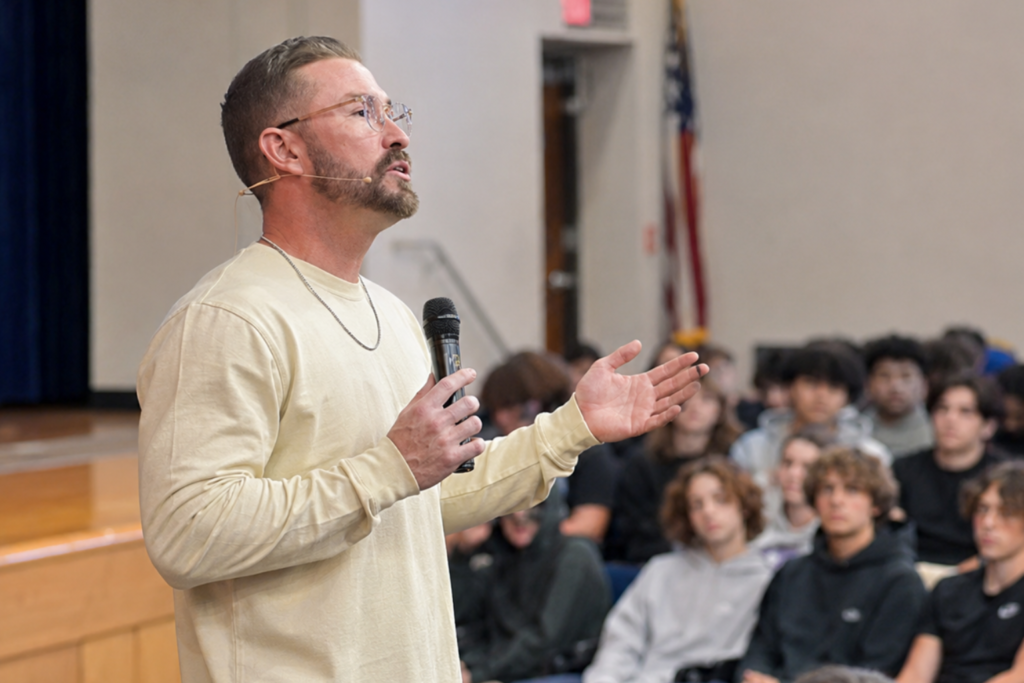
Tony Hoffman has spoken to schools, organizations, recovery communities, and churches across the country, earning a reputation as a speaker who gets results.
If you are ready to bring real talk about positive leadership, motivation, and what it means to develop leaders to your next event, contact us today or call us at 888-707-3880.
Tony’s message is for any person, team, or organization ready to lead with purpose and teach others to do the same.
Sources
PubMed Central. (March 23, 2022). The virtues of effective crisis leadership: What managers can learn …. PubMed Central.
Harvard Business School. (December 19, 2019). Leadership under pressure: 3 strategies for keeping calm. Harvard Business School Online.
Anderson University. (July 26, 2024). Spiritual grounding as an influence on servant leadership practice …. Anderson University Library.
Regent University. (January 9, 2026). The impact of organizational spirituality on employee well-being …. Regent University.
Liberty University. (No date). Exploring effective leadership styles in adolescent substance. Digital Commons @ Liberty University.
PubMed Central. (September 28, 2022). A positive psychology framework for why people use substances. PubMed Central.
PubMed Central. (September 17, 2012). Review of the application of positive psychology to substance use …. PubMed Central.
National Association of Addiction Treatment Providers. (August 8, 2025). Innovating recovery: How strengths-based approaches provide a …. NAATP.
Esade. (September 2, 2024). Top 10 characteristics of a good leader. Esade.
Johnson & Wales University. (April 20, 2021). 15 most important personality traits of effective leaders. Johnson & Wales University Online.
PubMed Central. (April 4, 2016). Personality profiles of effective leadership performance in …. PubMed Central.
University of Wisconsin-Stevens Point. (No date). Leadership’s guide to strengths based performance management. University of Wisconsin-Stevens Point.
PubMed Central. (August 14, 2021). Positive leadership and employee engagement: The roles of state …. PubMed Central.
National Center for Biotechnology Information. (No date). 6 group leadership, concepts, and techniques. National Center for Biotechnology Information.
PubMed Central. (January 4, 2023). Positive leadership action framework: Simply doing good and …. PubMed Central.
FAQ
What topics does Tony Hoffman cover as a leadership speaker?
Tony speaks on positive leadership, mental health, addiction recovery, student athlete empowerment, faith-based motivation, and leadership development. Each topic is rooted in his personal story and practical experience. He brings real-world principles that help people lead with confidence and purpose.
Is Tony Hoffman available to speak at schools?
Yes, Tony is one of the most sought-after speakers for middle schools, high schools, and colleges. His message connects directly with young people on subjects like motivation, substance abuse, and mental health. Schools across the country bring him in to inspire students to make better choices and step into leadership.
What makes Tony Hoffman different from other motivational speakers?
Tony is not reading from a script. He has lived through addiction, loss, and a full turnaround that most people only hear about in books. He combines leadership quotes and principles from thinkers like Peter Drucker, Warren Bennis, and Jon Gordon with his own story. That combination of hard truth and real hope is what makes his message land differently.
Can Tony speak at faith-based and church events?
Absolutely. Tony is a regular speaker at churches, youth groups, and Christian conferences. His faith is central to his story and his message, but he communicates it in a way that connects broadly. Whether your group is deeply rooted in faith or just beginning to explore it, Tony meets them where they are.
How do we book Tony Hoffman for an event?
Booking Tony is simple. Visit the contact us page to submit your event details, or call 888-707-3880 directly. His team responds quickly and works to fit your event’s goals, format, and audience. The sooner you reach out, the better your chances of securing your preferred date.
Author

Pro BMX athlete. Recovering addict. Motivational speaker. Tony Hoffman has lived several lives, and now he shares all of them. Since his release from prison in 2008, Tony has become one of the most powerful voices in mental health and substance abuse awareness.